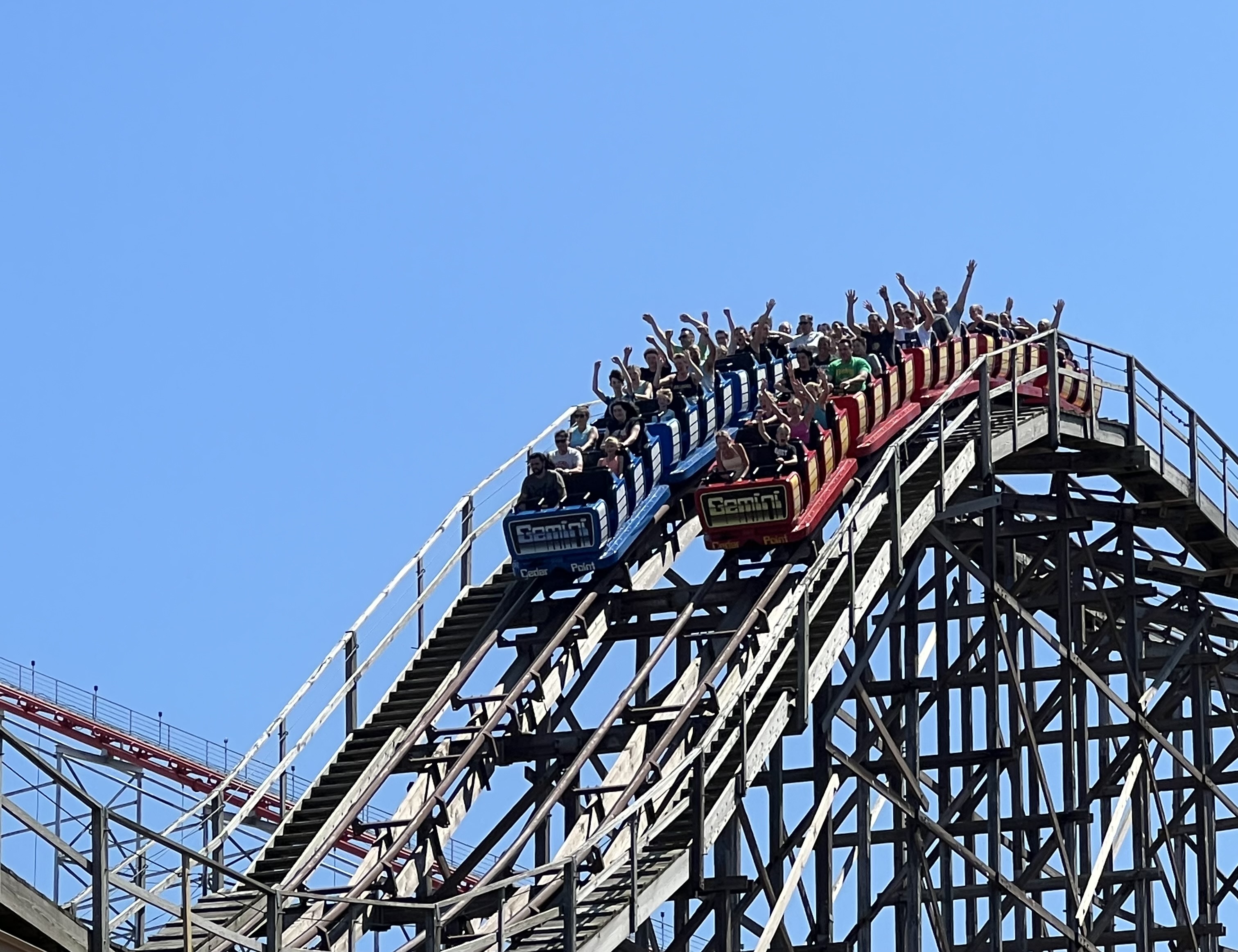
When Gemini opened at Cedar Point on June 17, 1978, it roared onto the amusement park scene as a groundbreaking attraction, heralded as the tallest, fastest, and steepest roller coaster in the world. While those bold claims weren’t entirely accurate, the twin-tracked racing coaster designed by Ron Toomer and built by Arrow Dynamics carved its place in amusement history with an innovative hybrid design and side-by-side racing that remains a signature experience at the self-proclaimed “Roller Coaster Capital of the World.”
Gemini arrived during a period of transformation for Cedar Point as the park, perched along the Lake Erie shoreline, sought to solidify its reputation as the “Disneyland of the Midwest.” In the 1960s and 1970s, the park expanded rapidly, adding Cedar Downs in 1968, the Cedar Creek Mine Ride in 1969, and the Corkscrew in 1976. By 1977, Cedar Point was poised for its next major leap forward.
The decision to build Gemini was finalized in late summer 1977, shortly after a devastating tornado swept through the area on June 30, clearing trees on the peninsula’s north end. Construction began that fall, though a brutal Ohio winter, including a record-setting blizzard in January 1978, delayed progress and pushed the ride’s debut to mid-season.
When it opened, Gemini stood 125.4 feet tall with a 118-foot drop at a 55-degree angle, reaching speeds of 60 mph across 3,935 feet of steel track. Its racing format, with parallel red and blue tracks, invites two trains to compete side by side, with riders often exchanging high-fives through tight curves and over hills. The two-minute, 20-second ride remains a favorite for its blend of classic thrills and interactive fun.
Gemini’s design, featuring tubular steel track atop a wooden support structure constructed with roughly 500,000 board feet of Douglas Fir, was revolutionary at the time. The steel-on-wood hybrid approach delivered the smooth ride of a steel coaster while preserving the aesthetic of a traditional wooden coaster—a formula that became influential in the evolution of modern ride engineering.
Though Cedar Point’s early marketing hailed Gemini as the world’s tallest, fastest, and steepest coaster, the ride’s records were quickly scrutinized. The Loch Ness Monster at Busch Gardens Williamsburg, which opened weeks earlier in 1978, stood taller at 130 feet, though with a shorter drop. Screamin’ Eagle at Six Flags St. Louis, which debuted in 1976, reached higher speeds at 62 mph. Still, Gemini distinguished itself with its high-capacity operation and racing format, helping to alleviate crowds and boost the park’s thrill ride lineup.
Originally, Gemini operated with six trains—three per track—capable of cycling up to 3,300 riders per hour. Over time, operational challenges led to a reduction to four trains, each with five cars seating 30 passengers.
The $3.4 million coaster also completed a significant expansion of Cedar Point’s midway, extending the park’s footprint by 1,140 feet as part of a broader development project that began with the Corkscrew two years earlier. Despite harsh winter weather that tested construction crews, the ride opened to eager crowds, helping cement Cedar Point’s standing as a thrill-seeker’s destination.
Gemini has given more rides than any other roller coaster at Cedar Point—a testament to its enduring popularity and reliability. Its location near the Gemini Midway and the family-friendly Wilderness Run coaster (originally Jr. Gemini) makes it a natural bridge between the park’s gentler attractions and its more extreme roller coasters.
In an era of record-breaking rides like Magnum XL-200 (1989) and Millennium Force (2000), Gemini has remained a park icon. Among Cedar Point’s current coaster lineup, only Blue Streak (1964), Cedar Creek Mine Ride (1969), and Corkscrew (1976) predate it.
Despite lacking inversions or towering heights, Gemini’s simplicity, nostalgia, and racing excitement continue to captivate fans. Many enthusiasts rank it among Cedar Point’s top five coasters when both tracks are racing.
While the station layout has changed over the years—from its original double-sided entry to a single rear entrance to improve guest flow—the spirit of competition and camaraderie endures. For generations of parkgoers, Gemini’s red and blue trains racing along the lakefront remain a symbol of classic thrills at Cedar Point.
For current ride information, tickets, or park hours, visit www.cedarpoint.com.
Find and follow me on Facebook, X, Instagram, and YouTube for more coverage of theme parks, travel, and roadside attractions.
Leave a Reply